
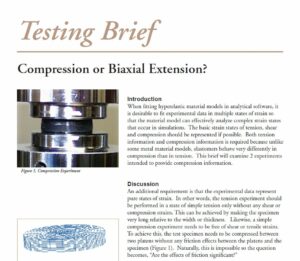
Compression of Biaxial Extension
Why is the biaxial extension experiment used for elastomers? Why is the compression test an undesirable test when developing test data for finite element analysis? This short paper addresses these questions.
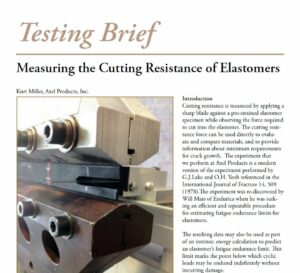
Measure Cutting Resistance of Elastomers
By Kurt Miller, Axel Products, Inc. Cutting resistance is measured by applying a sharp blade against a pre-strained elastomer specimen while observing the force required to cut into the elastomer. The cutting resistance force can be used directly to evaluate and compare materials, and to provide information about minimum requirements for crack growth. The experiment that we perform at Axel Products is described in this brief.
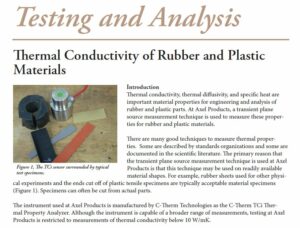
Thermal Conductivity of Rubber and Plastic Materials
This is a brief description of the operation of the transient plane source measurement technique used at Axel Products to measure the thermal conductivity of rubber and plastic materials.

Geothermal Cooling of Hydraulic Pawer Units at Axel Products
The use of geothermal cooling of hydraulic power supplies in the facilities of Axel Products is descibed.
C-Therm TCi Principles of Operation Introduction
By C-Therm Technologies. This document descibes the instrument used to measure thermal transport properties at Axel.
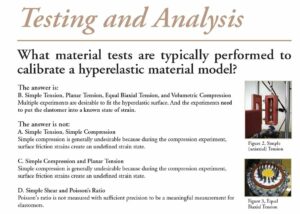
What Material Tests are Typically Performed to Calibrate a Hyperelastic Material Model?
This is a simple question and answer sheet with elastomeric experiment pictures and a brief explanation.
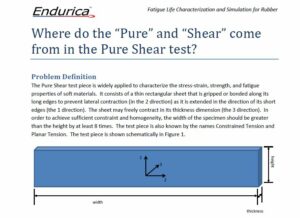
Where do the "Pure" and "Shear" come from in the Pure Shear test?
By Will Mars, Endurica LLC. Many people puzzle over the nomenclature of the pure shear test. They rightly point out that 1) the Pure Shear test piece is loaded in tension by extending the specimen in the axial direction, and 2) a shearing deformation, by definition, involves the lateral motion of parallel planes. They wonder where is the “shear”? and what does it mean to say that the shear is “pure”?
Elastomer Rate-Dependence: A Testing and Material Modeling Methodology
By Tod Dalrymple. Presented at the Fall 172nd Technical Meeting of the Rubber Division of the American Chemical Society, Inc. (PDF: 673 MB / 21 pages)
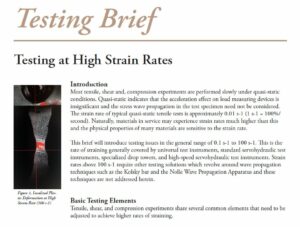
Disclaimer: This paper is somewhat out of date. Issues and pictures related to high strain testing are presented. Data for high strain rate testing of sheet steel, structural plastic and crushable foams is shown.
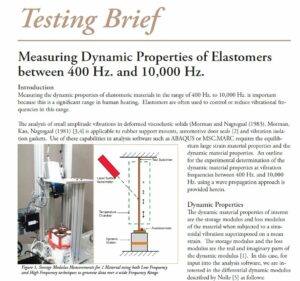
Measuring Dynamic Properties of Elastomers between 400 Hz. and 10,000 Hz.
Measuring the dynamic properties of elastomeric materials in the range of 400 Hz. to 10,000 Hz. is important because this is a significant range in human hearing. Elastomers are often used to control or reduce vibrational frequencies in this range. An outline for the experimental determination of the dynamic material properties at vibration frequencies between 400 Hz. and 10,000 Hz. using a wave propagation approach is provided herein.